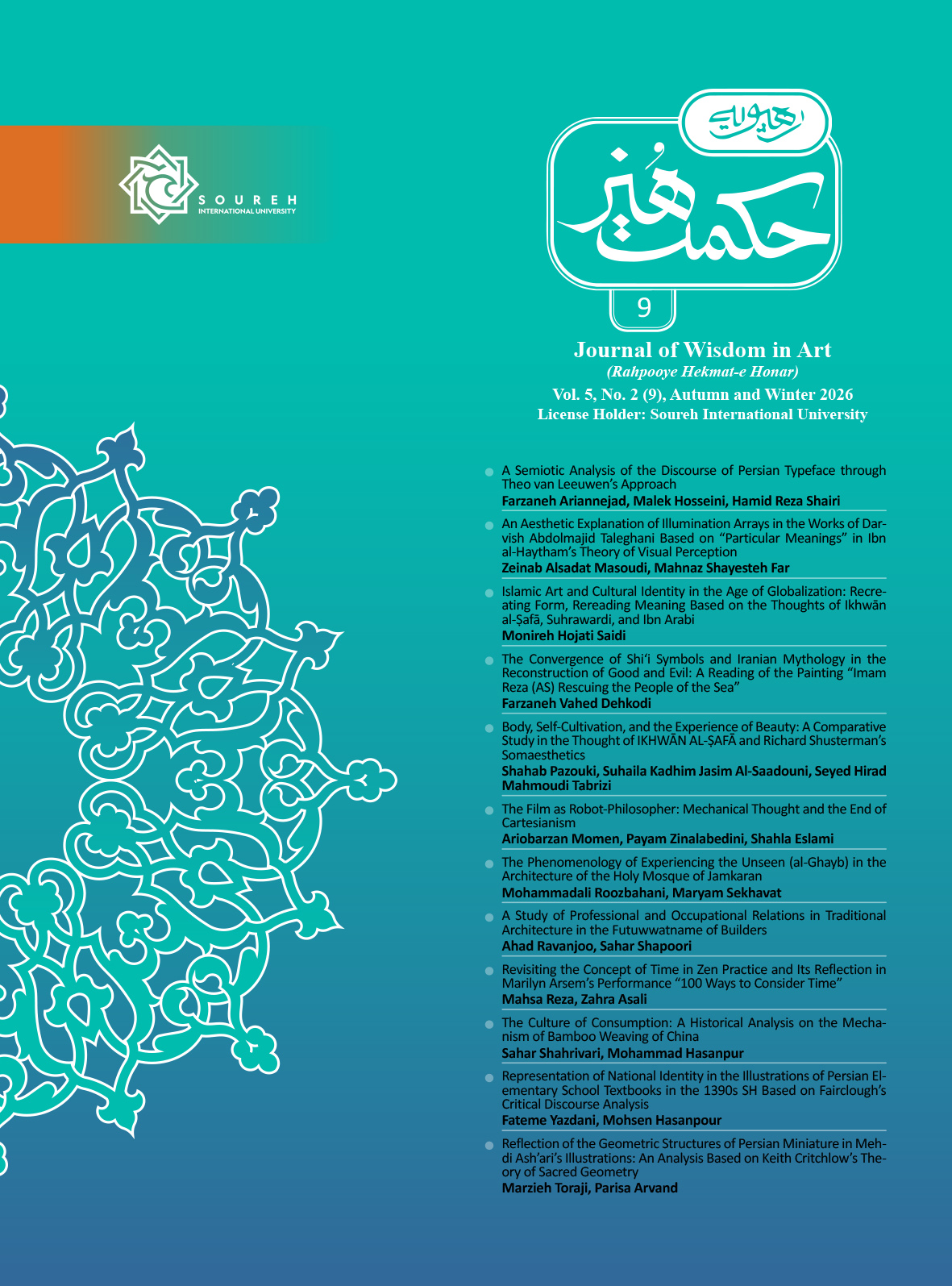
Rahppoye, Hekmat-e Honar

Rahppoye, Hekmat-e Honar

Body, Self-Cultivation, and the Experience of Beauty: A Comparative Study in the Thought of IKHWĀN AL-ṢAFĀ and Richard Shusterman’s Somaesthetics

Document Type : Original Article

Authors
1 Assistant professor ,Theory and Art Criticism Department, Research Institute of Arts, Affiliated with Iraninan Academy of art, Tehran, Iran (Corresponding Author).
2 Assistant teacher, Department of Art Education, College of Fine Arts, Almustaqbal University, Babylon-Hilla, Iraq.
3 M.A. in Art Studies, Sooreh International University, Tehran, Iran.
10.22034/rph.2026.2088238.1221
Abstract
The relationship between the body, self-cultivation, and aesthetic experience is a fundamental issue in contemporary philosophy, situated at the intersection of philosophical anthropology, ethics, and aesthetics. Throughout the history of philosophy, the body has often been understood through a dualistic framework. On the one hand, it has been regarded as the ground of human presence and perception in the world; on the other hand, in comparison with reason or soul, it has frequently been placed in an inferior ontological position. In many classical philosophical systems, the body was considered merely an instrument for attaining higher forms of perfection rather than an end in itself. As a result, its epistemic, ethical, and aesthetic capacities received limited attention.
In recent decades, however, philosophy—particularly aesthetics—has witnessed a body-centered turn that seeks to reconsider the role of the body in knowledge, meaning, and aesthetic experience. One of the most influential formulations of this approach is Richard Shusterman’s theory of somaesthetics. By challenging dominant dualistic traditions in Western aesthetics, Shusterman presents the body not simply as an object of perception but as the locus of awareness, a field of ethical practice, and a foundation for what he describes as the “art of living.”
Within this theoretical horizon, the present study offers a comparative analysis of the thought of Ikhwan al-Safa and Shusterman’s somaesthetics. The aim is to examine how both traditions, despite differences in their metaphysical foundations, regard the body as a medium of self-cultivation and aesthetic experience. The main objective of this research is therefore to explain and compare the role of the body in the process of self-cultivation and its relationship to aesthetic experience in these two intellectual traditions.
Three main research questions guide the study. First, how is the place of the body in the process of self-cultivation and existential training conceptualized in these two systems of thought? Second, what relationship is established between bodily harmony and the perception of beauty? Third, how can a theoretical explanation be developed that connects somaesthetics with a practical interpretation of body aesthetics in the thought of Ikhwan al-Safa?
The research adopts a qualitative and analytical-comparative approach. Data were collected through documentary and library research, focusing on the Epistles of Ikhwan al-Safa and the principal works of Richard Shusterman on somaesthetics. In the analytical stage, key concepts related to the body, self-cultivation, and aesthetic experience were extracted and compared through qualitative content analysis. The comparison was conducted along four axes: the ontological understanding of the body, the role of the body in knowledge and awareness, the position of the body in the process of self-cultivation, and the ultimate purpose of bodily cultivation.
The findings indicate that in the thought of Ikhwan al-Safa the body is understood within a hierarchical structure of existence in which the soul holds superiority over the body. Nevertheless, the body plays an essential role in the realization of the perfected human being. Within this framework, the body belongs to the natural world and occupies a lower ontological level than the spiritual dimension, yet it provides the necessary ground for the actualization of the soul’s capacities.
Ikhwan al-Safa regard the body as the instrument through which the faculties of the soul are manifested, the arena of ethical testing, and the site where purification and moderation are achieved. From this perspective, self-cultivation is not purely theoretical but requires bodily discipline, control of desires, moderation in daily habits, and the cultivation of virtuous practices. The body therefore becomes both the locus of desire and the field in which these desires are regulated. Consequently, the refinement of the body serves as a preliminary stage for the purification of the soul.
Ikhwan al-Safa also connect individual ethical reform with social harmony, suggesting that the proper cultivation of the body contributes to moral and social order. In this intellectual framework, beauty is closely associated with order, proportion, harmony, and the manifestation of divine order, while the ultimate aim of bodily discipline is the elevation of the soul.
By contrast, Richard Shusterman’s somaesthetics emerges as a critical response to the idealist metaphysical tradition in Western philosophy, which often placed the body in opposition to the mind and treated it as inferior. Shusterman challenges this dualistic conception and emphasizes the unity of body and mind. In his view, the body is not merely an instrument of the mind but the foundation of lived experience and the formation of human subjectivity.
He uses the concept of “soma” to refer to the living body in its biological, perceptual, and experiential dimensions. Shusterman also refers to several Asian philosophical traditions to demonstrate that attention to bodily awareness has long been central to practices of self-cultivation. From this perspective, self-cultivation involves bodily training, the development of somatic awareness, and the improvement of one’s mode of presence in the world.
The aim of somaesthetics is therefore not metaphysical transcendence but the enhancement of the quality of lived experience and everyday life. A cultivated body, in this framework, becomes a refined medium capable of generating richer and more conscious experiences. Beauty, accordingly, is not restricted to works of art but emerges from the harmonious interaction of body, environment, and awareness. A comparative examination of these two perspectives reveals several points of convergence.
Both challenge reductionist views of the body and reject the idea that the body is merely passive or marginal. Although Ikhwan al-Safa maintain the superiority of the soul, they still emphasize the indispensable role of the body in the process of spiritual development. Shusterman goes further by presenting the body and mind as integrated aspects of human existence. Both traditions also regard the body as a field of self-cultivation.
In Ikhwan al-Safa’s thought, the cultivation of the soul requires bodily discipline and moderation. Likewise, in Shusterman’s philosophy the body becomes the starting point of the project of self-cultivation, and its refinement leads to lasting transformations in experience and lifestyle. Furthermore, both perspectives connect beauty with harmony and proportion. Ikhwan al-Safa interpret beauty through cosmic order and balance, while Shusterman understands aesthetic experience as a quality of everyday life emerging from the harmonious interaction of body, environment, and awareness. Despite these similarities, important differences remain.
In the thought of Ikhwan al-Safa, the ultimate aim of bodily cultivation is the elevation of the soul and its return to the spiritual realm. In contrast, somaesthetics seeks to enhance the quality of life in the present world. Ikhwan al-Safa maintain a hierarchical ontology in which the soul is superior to the body, whereas Shusterman emphasizes their unity. Likewise, beauty in Ikhwan al-Safa is primarily related to divine and cosmic order, while in Shusterman’s philosophy it is closely connected with lived and embodied experience. Therefore, although both traditions recognize the body as a medium of human transformation, they differ in their interpretation of its final purpose.
In the first perspective, the body functions as a bridge toward spiritual transcendence, whereas in the second it becomes a site for enriching lived experience and cultivating creative ways of living. In conclusion, this study shows that the body occupies a central place in both traditions as a medium of human transformation. Ikhwan al-Safa view the body as a bridge toward transcendent truth, while Shusterman regards it as a basis for deepening experience and improving the quality of life. Despite these differences, both perspectives highlight the indispensable role of the body in human self-understanding and aesthetic experience. Rethinking the status of the body in both Islamic philosophical thought and contemporary Western philosophy therefore opens new perspectives for understanding self-cultivation and aesthetic life.
Keywords
Subjects

Balkhari Qahi, Hasan. (2014). The Shift from Rational Philosophy to Esoteric Wisdom in the Thought of the Ikhwan al-Safa (An Analysis of the First Encounter of Muslim Thinkers with Philosophy). [gerayesh az falsafe-ye aghli be hekmat-e bateni dar ara-ye Ikhwan al-Safa (tahlil-e nokhostin rooyaruyi-ye andishmandan-e mosalman ba falsafe)]. Tarikh-e Falsafeh, 5(2), 55–86. (In Persian)
Balkhari Qahi, Hasan. (2020). The Geometry of Imagination and Beauty: Focusing on the Views of the Ikhwan al-Safa. [hendese-ye khial va zibayi ba tamarkoz bar ara-ye Ikhwan al-Safa]. Moassese-ye Ta’lif, Tarjomeh va Nashr-e Asar-e Honari. (In Persian)
Balkhari Qahi, Hasan. (2021). The Ikhwan al-Safa’s Approach to Islamic Art. [rooykarde Ikhwan al-Safa be honar-e eslami]. In Hadi Rabiei (Ed.), Essays on the Nature of Islamic Art [jostarhayi dar chisti-ye honar-e eslami]. Farhangestan-e Honar. (In Persian)
Barati Pour, Hamidreza, Elmi, Ghorban, Latifi, Abdolhossein, & Jalali Shijani, Jamshid. (2021). Soul In The Treatises Of IKHWĀN AL-ṢAFĀ. Erfan-e Eslami, (68), 21–39. (In Persian)
Confucius. (2007). The Analects of Confucius. Trans. B. Watson. Columbia University Press.
Dobson, W. A. C. H. (Ed.). (1963). Mencius. University of Toronto Press.
Fakhoury, Hanna, & al-Jarr, Khalil. (2012). A History of Philosophy in the Islamic World [tarikh-e falsafe dar jahan-e eslami]. Trans. Abdolhamid Ayati. Sherkat-e Entesharat-e Elmi va Farhangi. (In Persian)
Hadot, Pierre. (1995). Philosophy as a Way of Life: Spiritual Exercises from Socrates to Foucault. Wiley-Blackwell.
Ikhwan al-Safa. (2024). The Complete Text of the Epistles of the Ikhwan al-Safa (4 vols.) [matn-e kamel-e rasa’el-e Ikhwan al-Safa]. Trans. Mohammad Ali Asgari. Moli Publications. (In Persian)
Nasr, Seyyed Hossein. (2024). Introduction [moqaddameh]. In The Complete Text of the Epistles of the Ikhwan al-Safa [matn-e kamel-e rasa’el-e Ikhwan al-Safa], trans. Mohammad Ali Asgari. Moli Publications. (In Persian)
Lau, D. C. (Trans.). (1963). Tao Te Ching. Penguin.
Nasr, Seyyed Hossein. (2005). Science and Civilization in Islam [elm va tamaddon dar eslam]. Trans. Ahmad Aram. Elmi va Farhangi Publications. (In Persian)
Pazouki, Shahab, & Taqavi, Ali. (2024). The Relationship between Shusterman's "Somaesthetics" and Baumgarten's "Aesthetics" and its Implications for Contemporary Aesthetics. Kimiya-ye-Honar, 13(53), 59–78. https://doi.org/10.22034/13.53.59  (In Persian)
Pazouki, Shahab, Kadhim Jasim Al-Saadouni, Suhaila, & Mahmoudi Tabrizi, Seyed Hirad. (2025). From Absolute Spirit to the Lived Body: A Critical Analysis of the Idealist System of Hegel’s Philosophy of Art in Light of Shusterman’s Theory of Somaesthetics. Kimiya-ye-Honar, 14(57), 21–41. https://doi.org/10.22034/14.57.2  (In Persian)
Sadati, Naser. (2023). A Comparison of authorial perception in Ikhwan al-Safa’s view with Gestalt perception in art based on the relationship between the whole and the parts. Motale’at-e Tatbiqi-ye Honar, 13(26), 63–78. https://doi.org/10.61186/mth.13.26.63  (In Persian)
Sharif, Mian Mohammad (Ed.). (1983). A History of Muslim Philosophy: With Short Accounts of Other Disciplines and the Modern Renaissance in Muslim Lands (4 vols.). [tarikh-e falsafe dar eslam]. Trans. Nasrollah Pourjavadi. Markaz-e Nashr-e Daneshgahi. (In Persian)
Shusterman, Richard. (1999). Somaesthetics: A Disciplinary Proposal. The Journal of Aesthetics and Art Criticism, 57(3), 299–313.
Shusterman, Richard. (2012a). Thinking Through the Body: Essays in Somaesthetics. Cambridge University Press.
Shusterman, Richard. (2012b). Body and the Arts: The Need for Somaesthetics. Diogenes, 59(1–2), 7–20.
Shusterman, Richard (Ed.). (2018). Aesthetic Experience and Somaesthetics (Vol. 1). Brill.
Shusterman, Richard. (2020). Somaesthetics in Context. Kinesiology Review, 9, 245–253.
Thera, N., & Bodhi, B. (2010). Anguttara Nikaya: Discourses of the Buddha, an Anthology (Part 1). The Wheel Publication.
Watson, Burton (Trans.). (1968). The Complete Works of Chuang Tzu. Columbia University Press.
Xenophon. (1990). Conversations of Socrates. Trans. H. Tredennick & R. Waterfield. Penguin.
 
Volume 5, Issue 2 - Serial Number 9
October 2026
Pages 57-69

  • Receive Date 08 May 2026
  • Revise Date 21 May 2026
  • Accept Date 23 May 2026