Rahppoye, Hekmat-e Honar

Rahppoye, Hekmat-e Honar

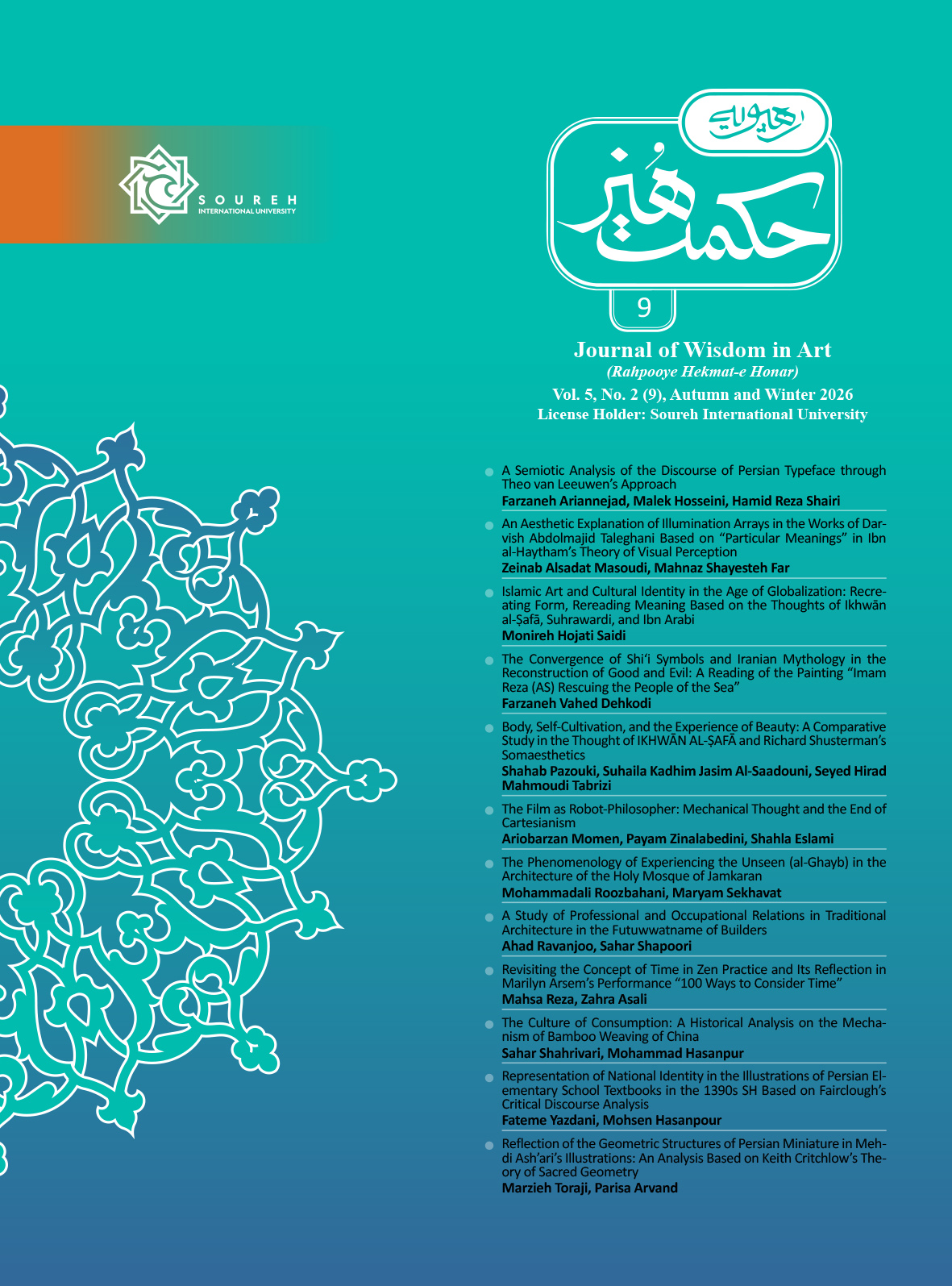
Islamic Art and Cultural Identity in the Age of Globalization: Recreating Form, Rereading Meaning Based on the Thoughts of Ikhwān al-Ṣafā, Suhrawardi, and Ibn Arabi

Document Type : Original Article

Author
Assistant Professor, Department of visual communication, La.C., Islamic Azad University, Lahijan, Iran.
10.22034/rph.2026.2092305.1232
Abstract
One of the central predicaments confronting art in the age of globalization is the risk that intercultural dialogue and exchange, rather than enriching cultural identity, may instead erode or distort it. As global cultural flows accelerate and homogenizing forces intensify, artistic traditions rooted in particular civilizations face mounting pressure either to dissolve into a placeless, deracinated visual language or to retreat into a defensive, static traditionalism that forecloses genuine dialogue with contemporary global audiences. Neither of these responses is adequate: the first sacrifices identity for intelligibility, while the second sacrifices relevance for authenticity. This paper argues that Islamic art, by virtue of its profound intellectual and metaphysical heritage, possesses the internal resources to escape this dilemma altogether. Drawing on the doctrines of the Ikhwān al-Ṣafā, Shihāb al-Dīn Suhrawardī, and Muḥyī al-Dīn Ibn ʿArabī, the study demonstrates that it remains possible today to produce works of art that retain a distinct and irreducible cultural identity while simultaneously being intelligible, resonant, and appealing to a global audience—provided that such production is grounded in the theoretical foundations of the Islamic wisdom tradition of art. The theoretical framework of the research is organized around three interlocking axes, each corresponding to one of these three intellectual traditions.
The first axis is the Ikhwān al-Ṣafā’s conception of art as a manifestation of cosmic order, number, and proportion. For the Brethren of Purity, the beauty of an artifact is not a matter of arbitrary taste but a reflection of the mathematical harmony underlying the created universe; number, geometry, and proportion are the visible traces of an intelligible cosmic order accessible to reason. This rationalist and structural foundation is significant for the present argument because it grounds artistic form in principles that are, in an important sense, universal and trans-cultural: proportion, symmetry, and geometric harmony can be apprehended and appreciated across cultural boundaries even by audiences unfamiliar with the specific theological or historical context of Islamic civilization. In this sense, the Ikhwān al-Ṣafā’s rationalist aesthetics supplies a bridge of intelligibility between Islamic art and global audiences, without requiring any dilution of the tradition’s substantive content.
The second axis is Suhrawardī’s Illuminationist philosophy (ḥikmat al-ishrāq), which centers on light (nūr) and intuitive unveiling (kashf, shuhūd) as the primary modes of both metaphysical knowledge and aesthetic experience. Where the Ikhwān al-Ṣafā emphasize discursive, rational apprehension of order, Suhrawardī shifts attention to the perceiver’s lived, experiential, and contemplative encounter with the artwork. Illumination is not merely a visual metaphor but an epistemic category: truth and beauty disclose themselves to the receptive soul through direct intuitive perception rather than solely through rational deduction. Applied to art, this framework suggests that an artwork’s capacity to move and transform its beholder does not depend on the beholder’s prior cultural or doctrinal literacy; the experience of luminosity, radiance, and contemplative depth can be intuitively grasped by any attentive viewer, regardless of cultural background. This axis therefore addresses the perceptual and experiential dimension of cross-cultural artistic communication, complementing the structural universality supplied by the Ikhwān al-Ṣafā.
The third axis draws on Ibn ʿArabī’s doctrine of the Unity of Being (waḥdat al-wujūd) and his theory of the manifestation (tajallī) of a single Truth (al-Ḥaqq) through an infinite multiplicity of forms (ṣuwar). For Ibn ʿArabī, no single form or interpretation exhausts the reality it manifests; every form is a locus of disclosure (maẓhar) that reveals the Real according to the receptivity (istiʿdād) of the perceiver. This metaphysics of multiplicity furnishes a robust theoretical warrant for polysemy, interpretive openness, and hermeneutic plurality within the language of art: a single artistic form can legitimately sustain multiple, even culturally divergent, readings without any one reading being reducible to mere subjective projection or without the work’s underlying unity being compromised. This axis is decisive for the paper’s argument because it explains, at the deepest metaphysical level, why Islamic art can accommodate—rather than merely tolerate—cultural diversity in reception: interpretive multiplicity is not a corruption of meaning but a manifestation of its very structure. Taken together, these three axes are not treated as separate or competing frameworks but as complementary dimensions of a single, integrated approach.
The paper proposes that the position of the artist working within this tradition should be reconceived: rather than being understood merely as a producer of objects, the artist is better understood as an agent operating at the intersection of three domains—”rational order” (derived from the Ikhwān al-Ṣafā), “spiritual intuition” (derived from Suhrawardī), and “multilayered interpretability” (derived from Ibn ʿArabī). The possibility of presenting Islamic art to a genuinely global audience, the paper argues, arises precisely at the point where these three domains cease to operate in isolation and instead become dynamically and creatively integrated within the process of artistic production itself. It is this integration—rather than any single one of the three principles taken alone—that allows a work to be simultaneously rooted and portable, particular and universal, traditional and contemporary.
Building on this three-part theoretical synthesis, the paper contends that the confluence of these approaches, at the level of both theory-building and artistic production, results in a productive rereading of meaning and a reinvention of form in contemporary art in the age of globalization. This approach, it is argued, allows Islamic art to avoid the twin dangers of mere imitation of the past on the one hand and the identity-less dissolution characteristic of globalization on the other. In other words, the framework offers a middle path between ossified traditionalism and rootless cosmopolitanism—a path that is neither nostalgic revivalism nor uncritical assimilation into a homogenized global visual culture.
In order to substantiate this argument, the paper seeks reasoned answers to four interrelated research questions. First, how is it possible to reinvent Islamic art in the age of globalization without severing it from its own epistemological and metaphysical foundations? Second, what specific roles do the intuitive approach (associated with Suhrawardian illumination) and the doctrine of the Unity of Being (associated with Ibn ʿArabī) play in the rereading of meaning within Islamic art? Third, what place do sacred geometry and numerical proportion—as theorized primarily through the Ikhwān al-Ṣafā—occupy in the reinvention of artistic forms and images in the era of globalization? Fourth, how can an artist working within the Islamic artistic tradition translate the confluence of these three approaches into a practical, applicable methodology for producing works of art that are genuinely appealing to a globalized contemporary audience?
In addressing these questions through a review of the aforementioned theoretical foundations, the paper endeavors to trace a meaningful line of connection along three related axes: first, between the past and the future of the Islamic artistic tradition; second, between tradition and innovation in the creation of artistic forms within that tradition; and third, between Islamic artworks and audiences situated within civilizational contexts different from that of Islamic civilization itself. The paper argues that establishing this three-fold connection renders both the rereading of the wisdom-based foundations (mabānī-yi ḥikmī) of Islamic art and the reinvention of its visual elements not merely desirable but effectively indispensable within the global arena and within the broader field of intercultural exchange.
Methodologically, the present study is fundamental (bunyādī) in its aim and qualitative in nature. The research method is descriptive-analytical, employing a comparative approach across the three philosophical traditions under discussion, with data collected through library-based (documentary) research. By placing the rationalist aesthetics of the Ikhwān al-Ṣafā, the illuminationist epistemology of Suhrawardī, and the metaphysics of multiplicity of Ibn ʿArabī into sustained dialogue with contemporary questions of cultural identity and globalization, the paper aims to contribute both to the theoretical literature on Islamic art and to the practical concerns of contemporary artists seeking to produce culturally rooted yet globally resonant work.
Keywords
Subjects

Avazpour, Behrooz; Shayeganfar, Nader; Namvar Motlagh, Bahman (2020). Artistic creativity in Suhrawardi's philosophy of illumination [Khalāqīyat-e Honarī dar Ḥekmat-e Eshrāq-e Sohrawardī]. Shenakht, 82(1), 173–193. (In Persian)
Balkhari Ghahi, Hassan. (2005). Mystical Foundations of Islamic Art and Architecture [Mabānī-ye ʿErfānī-ye Honar va Meʿmārī-ye Eslāmī]. Tehran: Sūreh Mehr. (In Persian)
Balkhari Ghahi, Hassan. (2009). The Geometry of Imagination and Beauty: A Study of the Ikhwan al-Safa's Views on Wisdom, Art and Beauty [Hendeseh-ye Khiyāl va Zībāyī]. Tehran: Farhangestan-e-Honar. (In Persian)
Balkhari Ghahi, Hassan. (2015). Qadr: A Theory of Art and Beauty in Islamic Civilization [Qadr: Nazariyyeh-ye Honar va Zībāyī dar Tamaddon-e Eslāmī]. Tehran: Sūreh Mehr. (In Persian) Giddens, Anthony. (2008). Runaway World: How Globalisation Is Reshaping Our Lives [Jahān-e Rahā Shodeh (Goftārhāyī dar Bāb-e Yekpārchegī-ye Jahān)]. Translated by Ali Asghar Saeidi & Yousef Hajji Abdolvahab. Tehran: Nashr-e Elm va Adab. (In Persian)
Golmohammadi, Ahmad. (2007). Globalization, Culture and Identity [Jahānī-shodan, Farhang, Hovīyat]. 3rd ed. Tehran: Nashr-e Ney. (In Persian)
Hekmat, Nasrollah. (2010). Wisdom and Art in Ibn al-Arabi's Mysticism [Ḥekmat va Honar dar ʿErfān-e Ibn al-ʿArabī]. 3rd ed. Tehran: Matn. (In Persian)
Ibn al-ʿArabi, Muḥyī al-Dīn. (2011). Al-Futūḥāt al-Makkiyyah [Al-Futūḥāt al-Makkiyyah] (4 vols.). Beirut: Dār al-Maʿrifah.
Ibn al-ʿArabi, Muḥyī al-Dīn. (1987). The Bezels of Wisdom [Fuṣūṣ al-Ḥikam]. Edited by Abū al-ʿAlā ʿAfīfī. Qom: Al-Zahrā. (In Persian)
 Jahangiri, Sara; Sharifzadeh, Mohamad Reza; Hasanvand, Mohamad Kazem (2025). A comparative study of the modernization of cultural and identity components in Islamic art with emphasis on globalization [Motāleʿeh-ye Taṭbīqī-ye Moʿāṣersāzī-ye Moʾallefeh-hā-ye Farhang va Hovīyat dar Honar-e Eslāmī bā Taʾkīd bar Jahānī-shodan]. Motale’at-e Syasi-Ejtemaey-e Tarikh va Farhang-e Iran, 3(3), 111–130. https://doi.org/10.61838/jspsich.3.3.7 (In Persian)
Jahanyar, Azar; Ranjbaran, Davood (2024). The foundations of mystical experience from Ibn al-Arabi's perspective and its place in art [Mabānī-ye Tajrobeh-ye ʿErfānī az Manẓar-e Ibn al-ʿArabī va Jāygāh-e Ān dar Honar]. Motale’at-e Ma’refati dar Daneshgah-e Eslami, 27(95), 55–76. https://doi.org/10.22034/ksiu.2023.95.55 (In Persian)
Rahimian Shirmard, Mohamad; Zahabi, Abbas (2018). The manifestation of beauty and artistic form in the light of Suhrawardi's illuminative philosophy [Ẓohūr-e Zībāyī va Heyʾat-e Honarī dar Partow-e Anwār-e Eshrāqī-ye Falsafeh-ye Sohrawardī]. Shenakht, 78(1), 167–186. (In Persian)
Ravanjoo, Ahad. (2025). A study of traditional art education in the chivalric tradition and futuwwat-nāma literature [Pazhūheshī dar Āmūzesh-e Sonnatī-ye Honar dar Āʾīn-e Fotovvat va Fotovvat-nāmeh-hā]. Rahpouyeh Hekmat-e Honar, 3(2), 53–66.
https://doi.org/10.22034/RPH.2025.2047829.1086 (In Persian)
Rezazadeh, Niloofar; Hekmat, Nasrollah; Zia Shahabi, Parviz; Shahroudi, Fatemeh (2018). The ontological relationship between art and human beauty and the Divine Names based on Ibn al-Arabi's mystical ontology [Tabyīn-e Nesbat-e Vojūdī-ye Honar va Zībāyī-ye Ensān bā Asmāʾ Allāh bā Hastī-shenāsī-ye ʿErfānī-ye Ibn al-ʿArabī]. Pajooheshhay-e Hasti Shenakhti, 7(13), 1–20. https://doi.org/10.1001.1.23453761.1397.7.13.1.4 (In Persian)
Robertson, R. (1992). Globality, global culture and images of world order. In H. Haferkamp & N. J. Smelser (Eds.), Social Change and Modernity. Berkeley: University of California Press.
Saeidi, Rahman. (2002). Local media and cultures in the age of globalization [Resāneh-hā va Farhang-hā-ye Būmī dar ʿAṣr-e Jahānī-shodan]. Faslnameh Olum-e Ejtema’ee, 9(17), 71–96. (In Persian)
Sarbannejad, Mohsen; Balkhari Ghahi, Hassan. (2023). Mīzān: A theory of art and beauty in Ibn al-Arabi's mysticism [Mīzān: Nazariyyeh-ye Honar va Zībāyī dar ʿErfān-e Ibn al-ʿArabī]. Rahpouyeh Hekmat-e Honar, 1(1), 39–46. https://doi.org/10.22034/RPH.2022.697031 (In Persian)
Sedaghat Samar Hosseini, Kamyar; Golshani, Mahdi; Taskhiri, Mohammad Ali. (2013). Globalization and culture in the thought of Arab intellectuals [Jahānī-sāzī va Farhang dar Andīsheh-ye Motafakkerān-e ʿArab]. Rāhbord-e Farhang, 23, 77–97. (In Persian)
Shafiei, Fatemeh; Fazeli, Alireza; Azadi, Mohammad Javad. (2014). Investigating the manifestation of the symbol of light in Islamic architecture [Barrasī-ye Tajallī-ye Ramz-e Nūr dar Meʿmārī-ye Eslāmī]. Negarineh-ye Honar-e Eslāmī, 1(3), 2–41. https://doi.org/10.22077/NIA.2014.496 (In Persian)
Suhrawardi, Shihab al-Din Yahya. (1998). The Philosophy of Illumination [Ḥikmat al-Ishrāq]. Translated by Seyyed Jaʿfar Sajjadi. Tehran: Daneshgah-e Tehran. (In Persian)
Suhrawardi, Shihab al-Din Yahya. (2001). Collected Works of Shaykh al-Ishrāq [Majmūʿeh-ye Moṣannafāt-e Shaykh al-Ishrāq]. Tehran: Pajooheshgah-e Olum-e Ensani va Motale’at-e Farhangi. (In Persian)
Suhrawardi, Shihab al-Din Yahya. (2005). The Philosophy of Illumination [Ḥikmat al-Ishrāq]. Translation and commentary by Seyyed Jaʿfar Sajjadi. Tehran: Daneshgah-e Tehran. (In Persian)
 
Volume 5, Issue 2 - Serial Number 9
October 2026
Pages 35-44

  • Receive Date 22 June 2026
  • Revise Date 11 July 2026
  • Accept Date 19 July 2026